
|
|
|
|
|
Information Disclaimer: This is an unofficial collection of European road sign conventions and rules. Whereas every effort has been taken to ensure the accuracy of the information presented, there may be errors and omissions.The entire risk as to results and performance of the information rests with its user.
 signals it, to remain in force until cancelled by
 .
.
 ,
or
,
or  .
As in the US, the effect of the latter two signs is the same, except one
also must stop at the STOP or the white line by the sign. Note that in most
countries the stop sign is of a different design. See our last page,
Signs of other European countries
before
a yield sign or before a stop sign, the cancellation sign is usually posted
nevertheless.
.
As in the US, the effect of the latter two signs is the same, except one
also must stop at the STOP or the white line by the sign. Note that in most
countries the stop sign is of a different design. See our last page,
Signs of other European countries
before
a yield sign or before a stop sign, the cancellation sign is usually posted
nevertheless.
 ,
and "yield to the cross street's right of way, .
The "my right of way" sign has validity only where posted, whereas
the sign "Vorfahrtstraße,"
would have significance beyond this one intersection, in that it would
turn the cross street into "Vorfahrtstraße" from there
to the cancellation point. There may be a STOP instead of the YIELD the
right of way.
,
and "yield to the cross street's right of way, .
The "my right of way" sign has validity only where posted, whereas
the sign "Vorfahrtstraße,"
would have significance beyond this one intersection, in that it would
turn the cross street into "Vorfahrtstraße" from there
to the cancellation point. There may be a STOP instead of the YIELD the
right of way.
| 1.) |
2.) |
3.) |
 |
 |
 |
| Traffic straight ahead | Traffic straight ahead | |
| (up on picture)has also right of way | to yield to traffic from right (Vorfahrtstraße!) |
| A stop sign outside town limits must be announced by the combination: | |
 |
 ,
and...."I shall yield to his right of way",
,
and...."I shall yield to his right of way",
 .
.
 ,
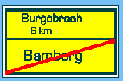
and....."end of town rules ,"
,
and....."end of town rules ,"
 ,
which is a sign legal in some countries and illegal in others. Where legally
posted, any traffic in the roundabout enjoys the right of way over traffic
coming from the junctions.Watch traffic ahead. Watch traffic as
it may enter from the side.
,
which is a sign legal in some countries and illegal in others. Where legally
posted, any traffic in the roundabout enjoys the right of way over traffic
coming from the junctions.Watch traffic ahead. Watch traffic as
it may enter from the side.
 , and
, and
 .
The country's Freeway default-speed limit, if any, applies. So do other
rules, which are essentially as follows.
.
The country's Freeway default-speed limit, if any, applies. So do other
rules, which are essentially as follows.
 , and
, and
 .
The same rules apply as for Autobahn, with the following exceptions.
.
The same rules apply as for Autobahn, with the following exceptions.
 return to the main page with its Table of Contents
 go
to the next page
go
to the next page
 return
to the last previous page
return
to the last previous page


© 1995-2010 Travlang Online, Inc. All rights reserved. webmaster@travlang.com

